Mooning With The Q


Posted 08/08/2012 - 07:47
Link
Absolute Crackers Adrian!!! Impressive.
Paul
Paul
K5's (2)both gripped, K10d gripped, Pentax 28-90 f3.5, Sigma 18-250mm, Sigma 150-500mm. Sigma 105mm f/2.8 EX DG Macro, Sigma 10-20 f.4-5.6.EX DC, Hoya 135 f2.8, Take on 28mm f2.8 Pentax AF360 flash, 2 fill in slaves. 30 metre remote release, Rt angle viewfinder, Giotto NOT 3261B Tripod with Manfrotto 808Rd4 ball head, Manfroto 4861RC2 monopoly, shoulder stock, various filters etc, Panasonic SET HBS HD Video cam, Tamrac Explorer 8x backpack and a sore back.....
-------------------------------------------------------
Photography is an index for measuring futility and pride.......
Paul
:wink
http://s743.photobucket.com/home/pg20_photos/index
https://www.flickr.com/photos/pg20
-------------------------------------------------------
Photography is an index for measuring futility and pride.......
Paul
:wink
http://s743.photobucket.com/home/pg20_photos/index
https://www.flickr.com/photos/pg20


Posted 08/08/2012 - 08:22
Link
Excellent use for the Q (at last)
Half Man... Half Pentax ... Half Cucumber
Pentax K-1 + K-5 and some other stuff
Algi
Pentax K-1 + K-5 and some other stuff
Algi

Posted 08/08/2012 - 08:25
Link
Nice one, dr.
Could be time for me to restart my rubbish attempts at moon photos!
Could be time for me to restart my rubbish attempts at moon photos!
This space deliberately left blank.

Posted 08/08/2012 - 10:44
Link
Great shots, good to be reminded what the moon looks like and the detail that can be achieved.
Pint o' rough & a game o' darts anyone

Posted 21/11/2012 - 13:35
Link
Well I'm still waiting for the right conditions for my high magnification project. It needs to be cold so the air is clear, but it has been unseasonably warm here. I had a practice last night, there was hazy cloud in front of the moon so far from ideal. But it allowed me to decide on my best setup and it does involve the Q with adapted lenses. There is plenty of fine tuning to do but I'm confident that I can get decent results:
The first is just a reference to show the areas photographed in higher magnification:

The area in red is roughly the area covered by this single, uncropped shot. I can get much higher magnification than this, but it becomes very difficult to work with. I might evetunally settle on a bit less. The arrow in the first indicates the Apollo XI landing site, which is just to the right of the larger twin craters in centre shot:
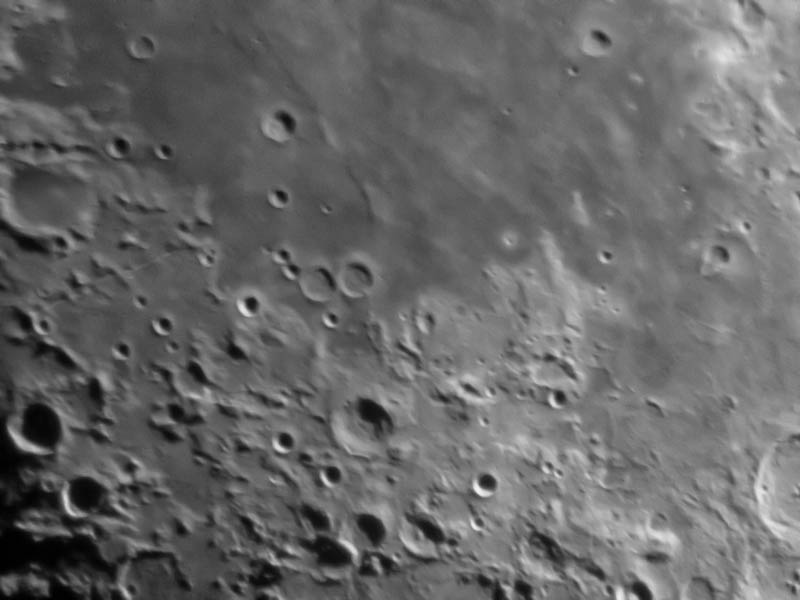
I should be able to get a better shot than that, it was hazy and my shutter speed was a bit low too. Nevertheless the idea is to stitch the full magnification shots and then reduce the size. Like this, which corresponds to the white area in the first shot:

That looks a lot better. And there are vast quantities of pixels to play with. The idea is to photograph the terminator over a dozen nights from the first quarter and last quarter phases and then stitch the out of shadow areas together to give a full moon with full surface detail. I might not achive that but I should at the least be able to get some shots of individual phases capable of very large prints. Full size would be around 30,000 pixels. Reducing that to around 12,000 pixels should result in a very decent quality metre wide print. If I can achieve consistent magnification each time I shoot, then I can build up a library of images which could be stacked to provide something rather impressive, although a 3metre print is probably too big.
What's the point of a technical exercise like this? Not much really, it helps if you like craters.
The first is just a reference to show the areas photographed in higher magnification:

The area in red is roughly the area covered by this single, uncropped shot. I can get much higher magnification than this, but it becomes very difficult to work with. I might evetunally settle on a bit less. The arrow in the first indicates the Apollo XI landing site, which is just to the right of the larger twin craters in centre shot:

I should be able to get a better shot than that, it was hazy and my shutter speed was a bit low too. Nevertheless the idea is to stitch the full magnification shots and then reduce the size. Like this, which corresponds to the white area in the first shot:

That looks a lot better. And there are vast quantities of pixels to play with. The idea is to photograph the terminator over a dozen nights from the first quarter and last quarter phases and then stitch the out of shadow areas together to give a full moon with full surface detail. I might not achive that but I should at the least be able to get some shots of individual phases capable of very large prints. Full size would be around 30,000 pixels. Reducing that to around 12,000 pixels should result in a very decent quality metre wide print. If I can achieve consistent magnification each time I shoot, then I can build up a library of images which could be stacked to provide something rather impressive, although a 3metre print is probably too big.
What's the point of a technical exercise like this? Not much really, it helps if you like craters.

Posted 21/11/2012 - 13:46
Link
All I can say is 'wow!'
Ken
“We must avoid however, snapping away, shooting quickly and without thought, overloading ourselves with unnecessary images that clutter our memory and diminish the clarity of the whole.” - Henri Cartier-Bresson -
“We must avoid however, snapping away, shooting quickly and without thought, overloading ourselves with unnecessary images that clutter our memory and diminish the clarity of the whole.” - Henri Cartier-Bresson -

Posted 21/11/2012 - 14:02
Link
gartmore wrote:
All I can say is 'wow!'
That's echoed down here.All I can say is 'wow!'
Also can I ask a question, do moon shots naturally come as black and white or is there a reason for the conversions other than taste.
Barrie - Too Old To Die Young
https://pentaxphotogallery.com/artists/barrieforbes
https://www.flickr.com/photos/189482630@N03/
https://pentaxphotogallery.com/artists/barrieforbes
https://www.flickr.com/photos/189482630@N03/
Posted 21/11/2012 - 14:06
Link
It was a palindromic response since today's date is too
Ken
“We must avoid however, snapping away, shooting quickly and without thought, overloading ourselves with unnecessary images that clutter our memory and diminish the clarity of the whole.” - Henri Cartier-Bresson -
“We must avoid however, snapping away, shooting quickly and without thought, overloading ourselves with unnecessary images that clutter our memory and diminish the clarity of the whole.” - Henri Cartier-Bresson -
Posted 21/11/2012 - 14:23
Link
bforbes wrote:
Also can I ask a question, do moon shots naturally come as black and white or is there a reason for the conversions other than taste.
I suppose it depends who takes them. It's a simple question but actually a complicated answer as the colour varies quite a bit according to the the time photographed relative to sunset. I find that optimal time varies upon the phase and for maximum detail the shooting window is often quite narrow. Sometimes my images are colour, sometimes b&w and sometimes I add a touch of blue to either. For stitching shots from different phases together then b&w is my best option.
gartmore wrote:
All I can say is 'wow!'
That's echoed down here.All I can say is 'wow!'
Also can I ask a question, do moon shots naturally come as black and white or is there a reason for the conversions other than taste.
Posted 21/11/2012 - 21:26
Link
Why on earth would I want to do that?
Add Comment
To leave a comment - Log in to Pentax User or create a new account.




2628 posts
16 years
Brighton,
England
This is from last night, same Moon phase. Q with FA43, uncropped. It is the lower right corner in the above shot:
This is a few shots from the same Q setup stitched together:
The K5 has it on IQ as to be expected. But not by that much. Furthermore the full sized image with the Q has around 15 times the pixel count of the same thing with the K! The close view I can't achieve with the K5 at anywhere near the quality.
The Q opens up a great project, which is to stitch together a full Moon shot with full crater detail from crops of shots like the second taken over the Moon's cycle (it will take several months). I need to get the magnification consistent, which could be tricky. The Q certainly is proving a valuable addition to the bag.