In our sequence of articles covering the different of series of Pentax cameras and lenses, John Riley researches the leap from manual focus to auto focus with the introduction of the F Series.
Posted: 25/09/2024 - 07:56
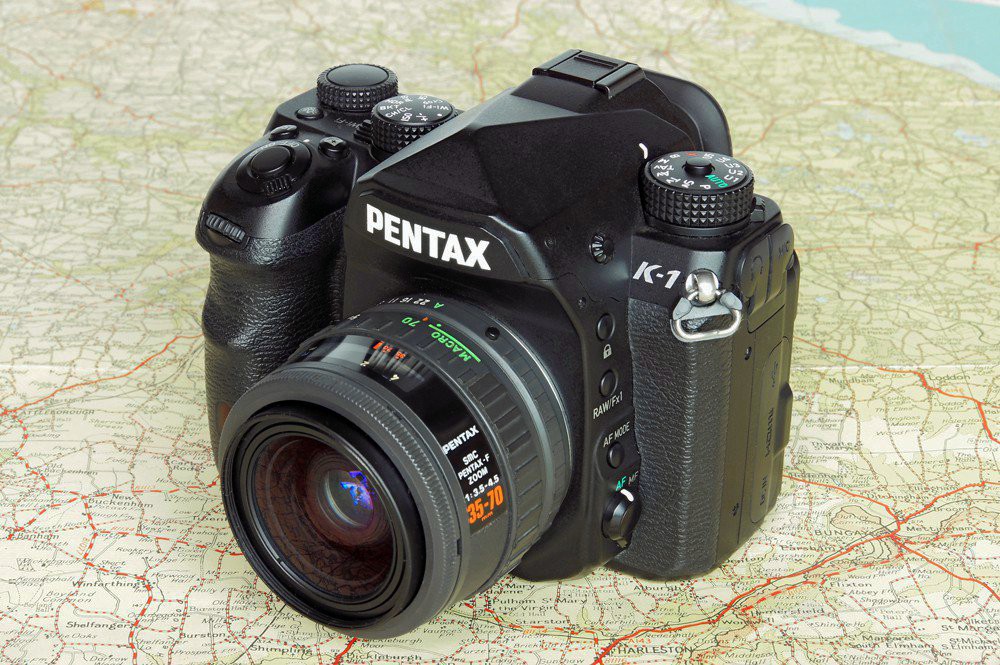
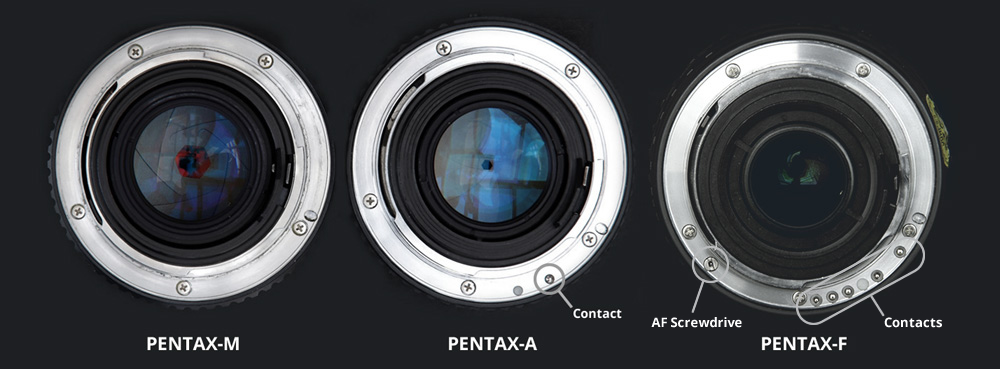
By 1987, the year the first truly AF camera was introduced into the Pentax range, the K bayonet mount had developed into the Ka mount, now carrying electronic contacts and enabling camera and lens to talk to each other. Add more connections and an AF drive shaft to the mount and we have the KAF mount, for which we also were given a new range of SMC Pentax-F lenses. This is a world away from the first attempt at AF, the Pentax ME-F with its dedicated AF lens. The new SF cameras and F lenses mark the point where AF systems become truly viable.
Let's first have a look at the three initial AF cameras, the SFX (SF1), SF7 (SF10) and SFXn (SF1n) and then at the new F lenses.
The Pentax SFX (SF1 in the USA)
The SFX was introduced in 1987 and was billed as a "Multi-Program Auto-Focus 35mm SLR with Retractable TTL Auto Flash". It is really a bit of a beast compared with the diminutive M series and A series cameras, weighing in at a relatively hefty 665g without its 2CR5 Lithium battery. It measures up at 154.5 x 99 x 63.5mm. It is a plastic based exterior, underneath which is a metal chassis. Battery life is quoted at 150 rolls of 24 exposure film without using the flash, or 30 rolls based on using the flash 50% of the time. Wind on during loading and shooting is motorised, a feature first seen in the Pentax A3.
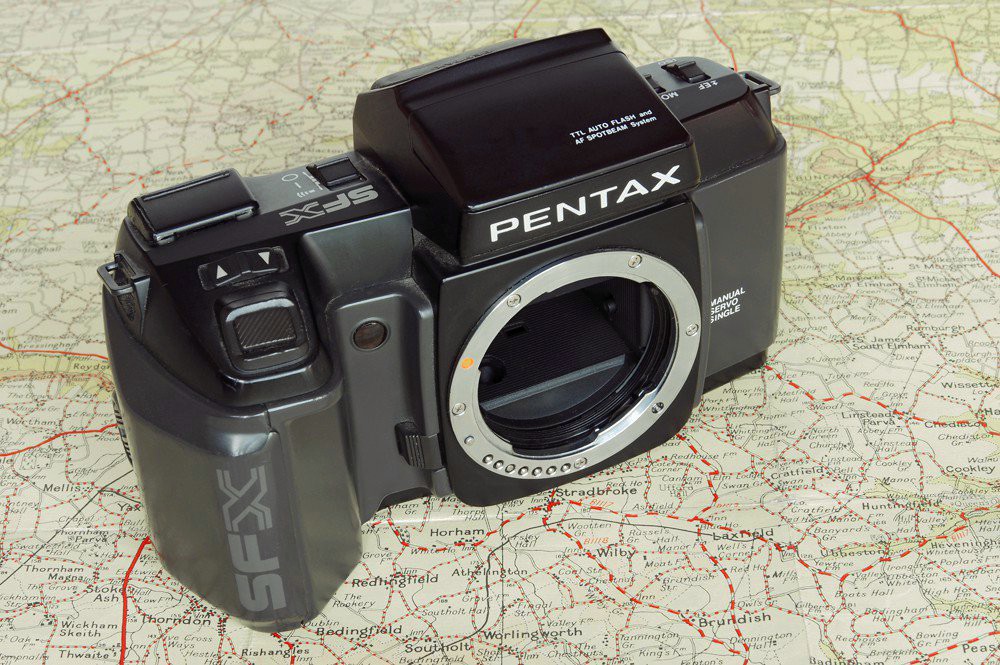
There are various features that are now considered standard fare but which were innovative at the time. There is a CENTIC display of settings on the top panel, electronic self timer, AF single, AF servo, MF, DX-coded film speeds as well as manual ISO setting and 9 program modes. The vertical run hybrid focal plane shutter is speeded from 1/2000s to 30s in auto and 1/2000s to 1s in manual. The hotshoe is placed unconventionally at the far right of the top plate.
There is no doubt this is a fine camera, although much more angular in its appearance and much bigger than Pentax Users might have been used to. Whether or not it can be considered an attractive looking camera is in the eye of the beholder, but it is efficient and functionally highly competent
The Pentax SF7 (SF10 in USA)
1988 brings a lower cost version to the market, called the SF7 (SF10 in the USA). There is a modest reduction in weight to 630g, a reduction in exposure metering range from 1-20 EV to 1-19 EV and a reduced number of program modes to the basic Av, M, P and Tv. At the same time, the drive rate is very slightly increased from 1.8fps to 2fps.
The Pentax SFXn (SF1n in USA)
Another year on, in 1989 the updated SFX appears, duly named the SFXn (SF1n in the USA). There are a few refinements such as a new top speed of 1/4000s and a slightly higher drive rate of 2.2fps.
| Pentax F Series Cameras | |||||
| Designation | Modes | Shutter range | EV range | Weight | |
|---|---|---|---|---|---|
| SFX (SF1 in USA) 1987 | P,A,S,M,P depth,P speed | 30s-1/2000s | 1 to 20 | 665g | |
| SF7 (SF 10) 1988 | P,A,S,M | 30s-1/2000s | 1 to 20 | 630g | |
| SFXn (SF 1n) 1989 | P,A,S,M,P depth,P speed | 30s-1/4000s | 1 to 20 | 665g | |
F Series Accessories
There are a number of useful accessories, including the Interval Data Back F, the Data Back FB, Battery grips including an AA grip, Remote battery packs, hotshoe adapters for off camera flash, Cable Switch F, IR remote release Cord F, Viewfinder magnifier FB, tele and wide angle flash adapters and a Wrist Grip Strap F.
The F Series Lenses
It would have been unrealistic to expect that all the existing lenses would be provided upfront with the new system, but of course Pentax, with their eye on backwards compatibility, came up with the unique and excellent SMC Pentax-F 1.7x AF Adapter. This was billed as being compatible with A series or other K bayonet lenses with an aperture of f/2.8 or faster, but with a modern DSLR such as the K-1 it seems quite possible to stretch this to f/4 and possibly slower lenses. The original list of officially compatible A series lenses is provided. It is also possible to use earlier K mount lenses with no electronic contacts, but in this case stop down metering will be needed. With a modern DSLR, the SMC Pentax-M 75-150mm f/4 zoom for example works perfectly well. No doubt improved AF systems help considerably to extend the usefulness of the AF adapter.

The AF adapter uses its internal elements to focus, so the manual focus lens used has to be prefocused into the ball park area, after which the adapter fine tunes the focus. This is not particularly onerous and with, for example, a 50mm standard lens it is hardly ever necessary to prefocus at all unless we are moving from a shot at infinity straight to a shot at the closest distances. The AF adapter does increase the focal length by 1.7x, so that needs to be kept in mind.
| A Series lenses Usable in AF mode with SMC Pentax-F AF Adapter 1.7x |
| SMC Pentax-A Fish-eye 16mm f/2.8 |
| SMC Pentax-A 20mm f/2.8 |
| SMC Pentax-A 24mm f/2.8 |
| SMC Pentax-A 28mm f/2 |
| SMC Pentax-A 28mm f/2.8 |
| SMC Pentax-A 35mm f/2 |
| SMC Pentax-A 35mm f/2.8 |
| SMC Pentax-A 50mm f/1.2 |
| SMC Pentax-A 50mm f/1.4 |
| SMC Pentax-A 50mm f/1.7 |
| SMC Pentax-A 50mm f/2 |
| SMC Pentax-A* 85mm f/1.4 |
| SMC Pentax-A 100mm f/2.8 |
| SMC Pentax-A* 135mm f/1.8 |
| SMC Pentax-A 135mm f/2.8 |
| SMC Pentax-A* 200mm f/2.8 ED |
| SMC Pentax-A* 300mm f/2.8 ED [IF] |
| SMC Pentax-A* 400mm f/2.8 ED [IF] |
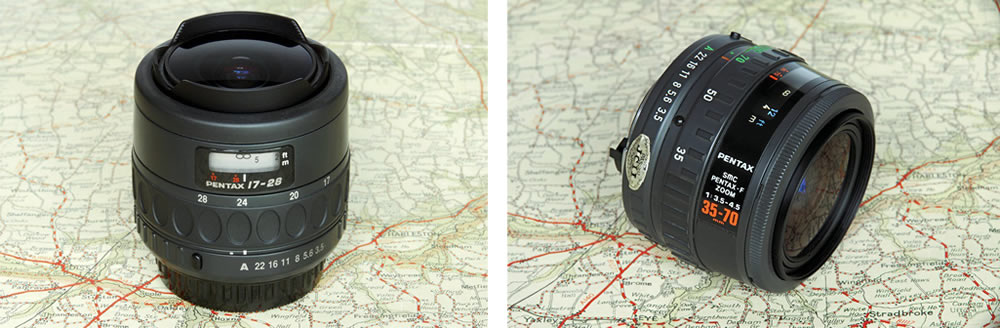
The F series lenses can be almost as compact as their A series equivalents, but in a new style and livery that is quite striking. The main body of the lenses tends to be a medium-dark grey as opposed to the traditional black and there is an extensive use of plastics. However, the quality is fine, things are just progressing and are different in many ways. In terms of general styling, the lenses do start off as a distinct new style of their own, but the very long ultra-telephotos retain the white design of previous ranges. Some of the lenses, such as the 17-28mm Fisheye zoom, are becoming more like the FA lens design that follows.
Apart from the conversion of primes to the F specification with its AF coupler, the arrival of AF also signals the arrival of the zoom lens in a big way. The 50mm continues to be a standard lens option, but alongside that there is the SMC Pentax-F 35-70mm f/3.5-4.5, which is almost as small and makes an excellent compact standard zoom. It also introduces the concept of the Macro setting on the zoom lenses, and at the 70mm end the zoom ring can be pushed past resistance to enter the Macro range, taking the focus down to a magnification of 1:4, or one quarter life size. This leaves us with a very close focus, but not a continuous range from here all the way back up to infinity. It works, but at the point we enter the macro range finding the right working distance can be slightly tricky. A continuous range would be better, but we have to wait for the FA series for that. One good feature is that the macro setting kicks in at the telephoto end, so a good working distance is assured. This is much more useful than if it were at the wide angle end of the range.
The F series was relatively short lived before morphing into the FA series, some of which are still in production. There are many very fine F series lenses to be found at quite reasonable prices, so they remain viable to this day. Often overlooked as a mere stepping stone in Pentax lens development, the F series merits closer attention and there are some very fine lenses to be enjoyed.
| Pentax F Series Prime Lenses | |||||
| Specification | Elements/Groups | Min Focus | Filter Size | Weight | Magnification |
|---|---|---|---|---|---|
| Wide Angle | |||||
| 28mm f/2.8 | 7/7 | 0.3m | 49mm | 180g | 0.13x |
| Standard | |||||
| 50mm f/1.4 | 7/6 | 0.45m | 49mm | 230g | 0.15x |
| 50mm f/1.7 | 6/5 | 0.45m | 49mm | 200g | 0.15x |
| Telephoto | |||||
| 85mm f/2.8 Soft | 5/4 | 0.5m | 52mm | 300g | 0.07x |
| 135mm f/2.8 [IF] | 8/7 | 0.7m | 52mm | 400g | 0.25x |
| Long Telephoto | |||||
| *300mm f/4.5 ED [IF] | 9/7 | 2m | 67mm | 880g | 0.17x |
| *600mm f/4 ED [IF] | 9/7 | 5m | 67mm | 6830g | 0.13x |
| Macro | |||||
| 50mm f/2.8 | 8/7 | 0.195m | 52mm | 385g | 1.0x |
| 100mm f/2.8 | 9/8 | 0.306m | 58mm | 590g | 1.0x |
| Adapter | |||||
| AF Adapter | 6/4 | N/A | N/A | 135g | 1.7x |
| Pentax F Series Zoom Lenses | |||||
| Specification | Elements/Groups | Min Focus | Filter Size | Weight | Magnification |
|---|---|---|---|---|---|
| Fish-Eye | |||||
| 17-28mm f/3.5-4.5 | 9/7 | 0.45m | N/A | 255g | 0.07x |
| Wide Angle | |||||
| 24-50mm f/4 | 11/10 | 0.4m | 58mm | 380g | 0.15x |
| 28-80mm f/3.5-4.5 | 12/9 | 0.8m/0.4m | 58mm | 395g | 0.11x/0.25x |
| Standard | |||||
| 35-70mm f/3.5-4.5 | 8/8 | 0.7m/0.32m | 49mm | 235g | 0.1x/0.25x |
| 35-80mm f/4-5.6 | 7/6 | 0.4m | 49mm | 185g | 0.25x |
| 35-105mm f/4-5.6 | 14/12 | 1.4m/0.42m | 58mm | 345g | 0.09x/0.25x |
| 35-135mm f/3.5-4.5 | 16/12 | 1.6m/0.75m | 58mm | 485g | 0.1x/0.25x |
| Telephoto | |||||
| 70-210mm f/4-5.6 ED | 13/9 | 1.1m | 49mm | 555g | 0.25x |
| 80-200mm f/4.7-5.6 | 11/7 | 1.1m | 49mm | 295g | 0.25x |
| 100-300mm f/4.5-5.6 | 12/8 | 1.5m | 58mm | 605g | 0.25x |
| *250-600mm f/5.6 ED [IF] | 17/15 | 3.5m | 189mm | 5400g | 0.20x |
| Non-SMC Lenses | |||||
| 28-80mm f/3.5-4.5 | 8/8 | 1m | 58mm | 408g | |
| 70-200mm f/4-5.6 | 10/8 | 1.1m | 49mm | 555g | |
| 70-210mm f/4-5.6 | 10/8 | 1.1m | 49mm | 555g | |
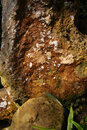
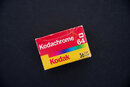
SMC PENTAX-F 35-70mm f/3.5-4.5 Sample Photos






































Related Articles
- Pentax K Series - The Original K Mount
- Pentax M Series - The Compact SLR
- Pentax A Series - The Arrival of the KA Mount
- Pentax FA Series Lenses
- Pentax Digital Lenses
- Asahi Photo - Pentax Repair Specialist
Add Comment
To leave a comment - Log in to Pentax User or create a new account.