With over 15 years in continuous production, John Riley revisits this versatile Pentax all-in-one walkaround solution. Does the Pentax 18-135mm match up to modern expectations? With sample photos, MTF & CA charts along with further reflection John provides the answers.
Posted: 06/03/2026 - 15:12
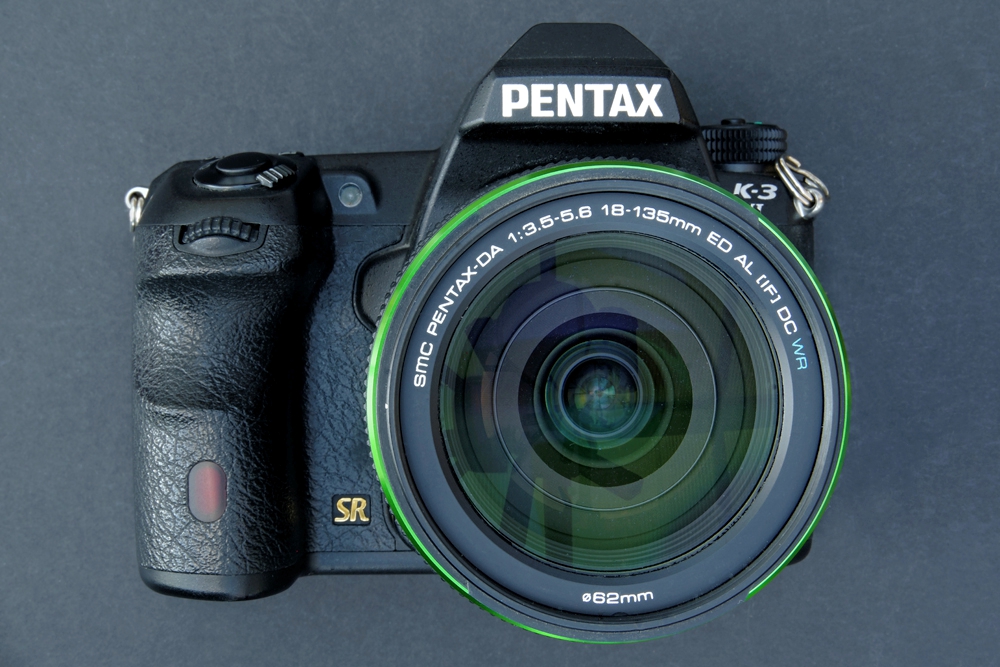
Intended for the APS-C format crop sensor DSLR range, Pentax's 18-135mm lens has a very useful extended “35mm format equivalent” field of view similar to a 27.7-207mm full frame lens. This is what was once described as a “super-zoom” and would typically be 28-200mm or thereabouts. The lens has been around for a very long time, and was originally looked at in 2011, then coupled with the 16MP Pentax K-5. Some fifteen years later, we use two of these lenses for almost all our photography from travel to technical shots to product shots, so there must be something that makes the 18-135mm a lens of choice. Can it possibly stand up to the requirements of the latest high resolution sensors? Currently being used with the 25.7MP Pentax K-3 Mark III body, it's time for a complete re-assessment of this venerable optic to see exactly what its magic might be.
Handling and Features
Sturdily made of quality plastics, and with an excellent, smooth fitting metal mount, the lens is clearly well made. It is compact and chunky in appearance. Weight is a modest 405g and dimensions just 73.0mm x 76.0mm. The lens body has “simplified” weather resistance; in practice over the 15 years in use, this has meant successfully surviving horrendous rainstorms, although obviously this is not guaranteed. We push this as far as we are comfortable with, as the benefits of the glorious colours revealed by rain are worth taking a few chances for. Or not, as we decide for ourselves. One sensible precaution is to wipe the extended barrel dry before moving from full zoom back towards wide angle, as the lens extends some way and can become very wet in rain. The front element is treated with a Super Protect coating that resists dust, moisture and grease.
There is a supplied bayonet fit lens hood that clips firmly and smoothly into place, and still does on both the lenses we own. There is a small removable cover that reveals the edge of any filter fitted and means, for example, that a polariser can be rotated without removing the hood. The filter size is 62mm.
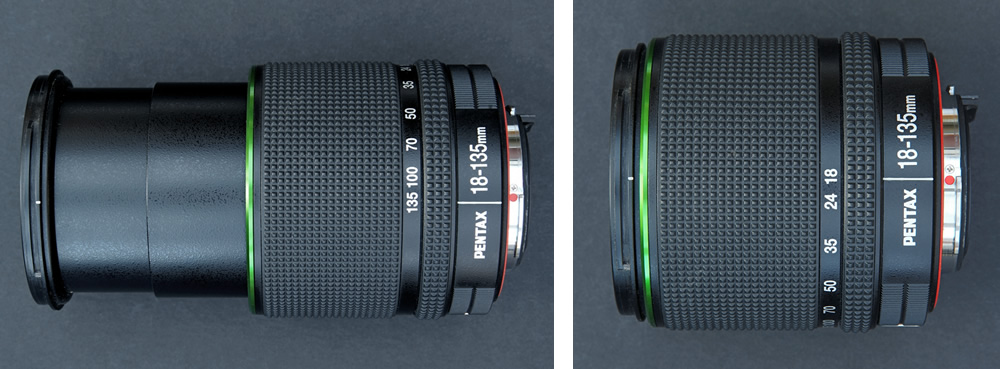
The wide zoom ring has a good grip. It is clearly marked with focal lengths of 18mm, 24mm, 35mm, 50mm, 70mm, 100mm and 135mm. These settings are close to the actual focal lengths as reported by Photoshop.
Behind this, closest to the camera body, is the thinner manual focus ring. If the OK button on the camera is pressed with Live View activated, a magnified view of the image is shown and this makes manual focusing very easy indeed. Also this is probably the most accurate way to achieve perfect focus for highly critical situations. Thinking of closer shots, there is also a QuickShift clutch mechanism fitted, so if using AF when focus has been achieved it can be manually adjusted without any need for engaging a special mode. This is very useful for small item photography.
Focusing is down to 40cm at 135mm, gives a maximum magnification of 0.24x, approximately 1:4. Internal Focusing means the lens does not alter length. AF is driven by a DC motor and this is moderately quiet, and definitely fast and accurate. There is no SR (shake reduction) built into the lens, this being supplied by the camera body. It is effective and offers somewhere around 5.5 stops of advantage.
Optical construction is 13 elements in 11 groups, including 2 Aspheric and 1 ED (Extra Low Dispersion). The diaphragm comprises 7 curved blades to provide as rounded an aperture as possible. Pentax's SMC coating is well established, although now replaced by their even more effective HD coating.
Operational temperature for the lens is from -10C to +40C, which is a better range than many much more expensive optics. Rain, shine or cold we keep on shooting.
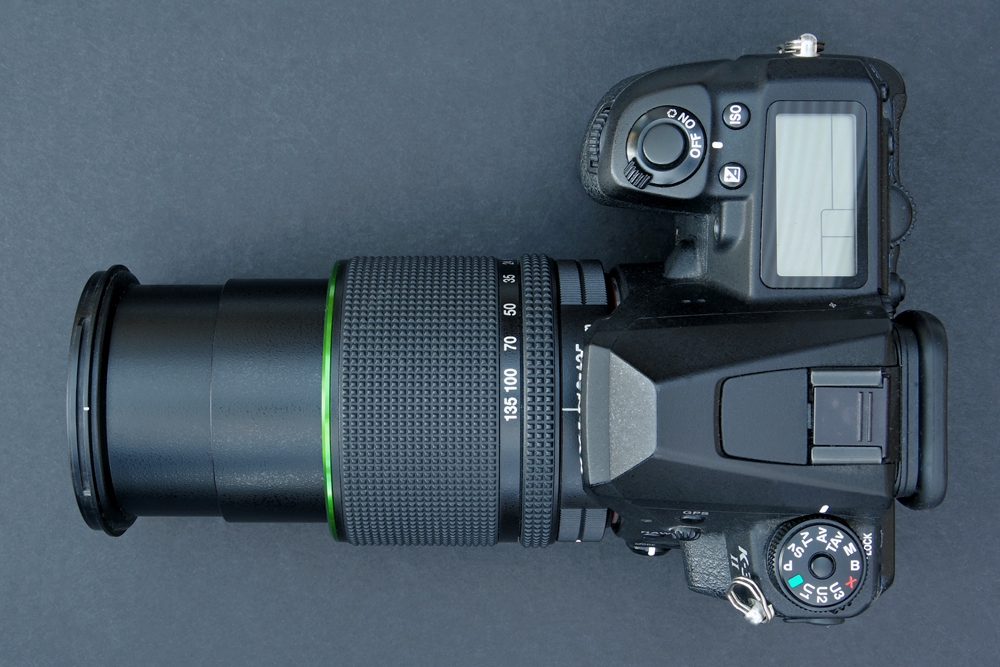
The lens is fitted with a KAF3 mount variant, which means that it has a built in AF motor and no shaft for screw drive. All cameras from the K-5 onwards are supported. The AF performance is still up to speed with the latest bodies and also accurate. The system is particularly good at differentiating between detailed areas (such as tree branches) and a small subject (such as a small bird). There is also QuickShift to fall back on to make any last minute tweaks to the focus position.
Handling is absolutely a doddle, this incredibly versatile lens can cover almost anything thrown at it. That we still use two of them almost universally after 15 years must say something, but the final judgement of course as always depends on the level of quality delivered. So, time for the technical tests.
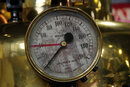
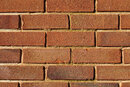
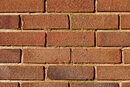
SMC PENTAX-DA 18-135mm f/3.5-5.6 ED AL [IF] DC WR Sample Photos




















Performance
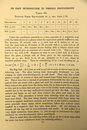
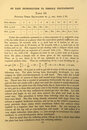
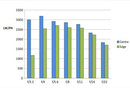
At 18mm, central sharpness is excellent from f/3.5 right through to f/11, very good at f/16 and good at f/22. The edges are fair at f/3.5, very good at f/4, excellent at f/5.6, very good from f/8 to f/16 and good at f/22.
At 35mm, central sharpness is very good from f/4.5 to f/11, good at f/16 and fair at f/22 and f/32. The edges are very good from f/4.5 to f/11, good at f/16 and fair at f/22 and f/32.
At 70mm, central sharpness is very good from f/4.5 to f/16 and good at f/22 and f/32. The edges are good at f/4.5, very good from f/5.6 to f/16 and fair at f/22 and f/32.
At 100mm, central sharpness is very good from f/5.6 to f/16, good at f/22, fair at f/32 and soft at f/40. The edges are very good from f/5.6 to f/16, good at f/22, fair at f/32 and soft at f/40.
This is a very creditable performance. It's clear that we can't go far wrong using the lens from open apertures as far down as f/16, after which (unsurprisingly) diffraction takes its toll. The results are sharp and crisp.
SMC PENTAX-DA 18-135mm f/3.5-5.6 ED AL [IF] DC WR MTF Charts
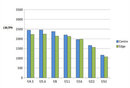
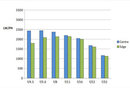
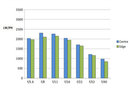
CA (Chromatic Aberration) is well controlled centrally, and even at the edges there is very little sign of colour fringing. If necessary, further correction in software could be made, but for most subjects this is very unlikely to be needed.
SMC PENTAX-DA 18-135mm f/3.5-5.6 ED AL [IF] DC WR Chromatic Aberration Charts
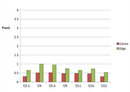
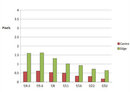
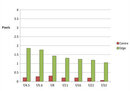
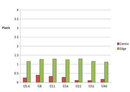
Distortion measures just -0.18% barrel at 18mm, +0.18% pincushion at 35mm, -0.10% barrel at 70mm and -0.03% barrel at 100mm. No doubt the camera itself contributes to this very high standard.
Bokeh is the smoothness of gradation in the out of focus areas in an image. Results are very pleasing from this lens, with very smooth out of focus gradation.
SMC PENTAX-DA 18-135mm f/3.5-5.6 ED AL [IF] DC WR Aperture Range







It is very difficult to induce any sort of flare, even with severe lighting conditions. Regardless of whether the newer HD coating is better still, this shows that the SMC coating is still able to deliver clean, sharp flare free images.
Vignetting is also impressively under control.
| Aperture | 18mm | 35mm | 70mm | 100mm |
|---|---|---|---|---|
| f/3.5 | -1.2 | |||
| f/4 | -1 | |||
| f/4.5 | -0.3 | -1.5 | ||
| f/5.6 | -0.6 | -0.3 | -1.4 | -1.1 |
| f/8 | -0.6 | -0.3 | -1.1 | -0.5 |
| f/11 | -0.6 | -0.3 | -1 | -0.5 |
| f/16 | -0.6 | -0.3 | -1 | -0.3 |
| f/22 | -0.6 | -0.3 | -1 | -0.2 |
| f/32 | -0.3 | -1 | -0.2 | |
| f/40 | -0.2 |
Value for Money
The SMC Pentax-DA 18-135mm f/3.5-4.5 ED AL [IF] DC WR Lens is priced at £549.99, although other offers were found at £499 and even £449.
Looking at MPB, recently there's been two used choices on offer:
- Good condition, £129
- Excellent condition, £149.
By way of comparison with other marques, which cannot be used on Pentax cameras of course:
- Fujifilm XF 18-135mm f/3.5-5.6 WR LM R OIS, £699
- Sony E 18-135mm f/3.5-5.6 OSS, £489
That looks to be excellent VFM, and the second hand prices could be described as “a steal”.
Verdict
Even more so than when originally launched, this lens is just universally useful and can cover almost every possible type of subject. In situations where the relatively limited maximum aperture is a problem it is possible to use higher ISO values and still have good results even at ISO 6400. The close focus is not down to macro distances of 1:1 or 1:2 magnification, but not so far off, with 1:4 meaning small objects can be easily tackled. The reach at 135mm (200mm equivalent) brings close sports and wildlife in. Travel, reportage, portrait, close ups and really most subjects that do not require specialist lenses can be effectively covered.
The purpose of this review has been to re-evaluate this ubiquitous lens using the latest camera body and sensor. This is especially in the light of these two examples of the lens having been in constant use for 15 years. The results can be clearly seen in product shots for reviews, which are almost entirely shot with the actual lenses here on test. They have both lasted perfectly, with no slackness and virtually no wear to engravings and general finish.
The lens has definitely earned its way over the past 15 years, and is quite literally an Editor's Choice.
Pros
- Very good to excellent sharpness
- Minimal distortion
- Fast, accurate and quiet AF
- Excellent flare resistance
- CA well controlled
- Very useful zoom range
- Weather resistance
- Magnification 1:4 at 135mm
- Modest vignetting
- Excellent pricing
Cons
- No distance scale
- No DOF scale
Specifications: SMC PENTAX-DA 18-135mm f/3.5-5.6 ED AL [IF] DC WR |
||||
| General | ||||
| Focal Type | Super zoom | |||
| Lens Mounts | Pentax KAF3 | |||
| Availability | ||||
| Year announced | 2010 | |||
| Discontinued | No | |||
| Dimensions | ||||
| Diameter | 76mm | |||
| Width | 73mm | |||
| Weight | 405g | |||
| Construction | ||||
| Weather-sealed | Yes | |||
| Groups | 11 | |||
| Elements | 13 | |||
| Blades | 7 | |||
| Lens | ||||
| 35mm equivalent | 27.7 - 207mm | |||
| Stabilised | No | |||
| Filter Size | 62mm | |||
| Min Aperture | f/22 - 40 | |||
| Max Aperture | f/3.5 - 5.6 | |||
| Focal Length | 18 - 135mm | |||
| Focusing | ||||
| Macro | No | |||
| Min Focus | 40cm | |||
| Focusing Type | Automatic, Manual | |||


Sigma 10-20mm f4-5.6, Tamron 17-50mm f2.8, Pentax 16-85mm, Pentax DA 20-40 ltd
Pentax 21mm f3.2 ltd, Sigma 24mm f2.8 macro, Pentax 35mm f2.8 macro, Pentax 50mm FA f1.7, Pentax A 50mm f1.7, Pentax K 55mm f1.8, Pentax DA* 55mm f1.4
Metz 36 AF-4

Add Comment
To leave a comment - Log in to Pentax User or create a new account.


57 posts
16 years
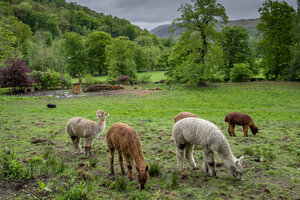
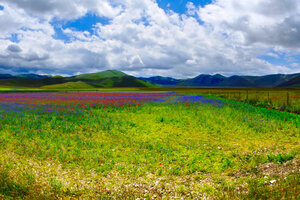
It also works great with my K-M.
Pic taken with my K5II plus 18-135mm:
link