Grad filter sizes

Posted 05/07/2010 - 23:10
Link
It depends on what holder you're using.
The cokin z-pro is a 100mm holder that holds 3 filters and is rated up to 20mm (35mm format) so 13mm APS-C so comparable holders might be the same.
The Z-pro holder can be adapted and it can then easily fit 10mm for APS-C and maybe even wider?
The cokin z-pro is a 100mm holder that holds 3 filters and is rated up to 20mm (35mm format) so 13mm APS-C so comparable holders might be the same.
The Z-pro holder can be adapted and it can then easily fit 10mm for APS-C and maybe even wider?
Stefan

K10D, K5
DA* 16-50, DA* 50-135, D-FA 100 Macro, DA 40 Ltd, DA 18-55
AF-540FGZ

K10D, K5
DA* 16-50, DA* 50-135, D-FA 100 Macro, DA 40 Ltd, DA 18-55
AF-540FGZ

Posted 06/07/2010 - 00:09
Link
Sorry I'm not worried about the 100mm fitting the Sigma (the grad maker I'm looking at, Formatt/Hitech, has a special wide angle holder) - I'm worried about whether on my Pentax lenses (which do not have the Sigma's huge front element) the filters will be unsuitable because most of the gradation is spread over an area the lens doesn't 'see'
Posted 06/07/2010 - 00:38
Link
Ah okay, you're worried about the transition.
It's actually the angle of view that matters the most not the front element.
So for wide angle lenses soft is most of the time better but for normal to long you can get hard ones, you can even special order ones with an razor edge for tele lenses.
I think it's quite hard to make a define line when to use which type of transition since also the type of photo matters.
Seascape for example hard ones are better but if you've hills and trees a soft one is better.
You're having the same problem if you go for smaller filters because it's the transition that matters and that's roughly the same on each size although just read it does differ from brand (didn't knew that).
Hi-tech hard are softer then lee hard I just discovered.
It's actually the angle of view that matters the most not the front element.
So for wide angle lenses soft is most of the time better but for normal to long you can get hard ones, you can even special order ones with an razor edge for tele lenses.
I think it's quite hard to make a define line when to use which type of transition since also the type of photo matters.
Seascape for example hard ones are better but if you've hills and trees a soft one is better.
You're having the same problem if you go for smaller filters because it's the transition that matters and that's roughly the same on each size although just read it does differ from brand (didn't knew that).
Hi-tech hard are softer then lee hard I just discovered.
Stefan
K10D, K5
DA* 16-50, DA* 50-135, D-FA 100 Macro, DA 40 Ltd, DA 18-55
AF-540FGZ
K10D, K5
DA* 16-50, DA* 50-135, D-FA 100 Macro, DA 40 Ltd, DA 18-55
AF-540FGZ
Posted 06/07/2010 - 10:23
Link
My concern is really whether I'll have sufficient control via using the 100mms: with the darkest section at the very top, I'm not sure I'll be able to use it without having the whole scene darkened on my smaller-element lenses.


Posted 06/07/2010 - 11:52
Link
MrCynical wrote:
My concern is really whether I'll have sufficient control via using the 100mms: with the darkest section at the very top, I'm not sure I'll be able to use it without having the whole scene darkened on my smaller-element lenses.
You slide them up and down as well as rotate them to put the dark bit where you want it.
My concern is really whether I'll have sufficient control via using the 100mms: with the darkest section at the very top, I'm not sure I'll be able to use it without having the whole scene darkened on my smaller-element lenses.
Ken
“We must avoid however, snapping away, shooting quickly and without thought, overloading ourselves with unnecessary images that clutter our memory and diminish the clarity of the whole.” - Henri Cartier-Bresson -
“We must avoid however, snapping away, shooting quickly and without thought, overloading ourselves with unnecessary images that clutter our memory and diminish the clarity of the whole.” - Henri Cartier-Bresson -

Posted 06/07/2010 - 13:01
Link
You are right - with the 100mm ND grad there is little control when using, say, a 49mm filter thread
It becomes more pronounced when trying to use telephoto on the Z-Pro ND grad - it just becomes a controllable ND, rather than a grad.
There's a bit of combination between filter size and focal length. So, a 67mm filter at 24mm isn't too bad on the Z-Pro size. But a 67mm filter at 150mm isn't really grad anymore.
I've kept a couple of P-size ND grads for this purpose. However, in general I have to say I rarely use even the ND grads - using multiple exposures if absolutely necessary.
Hope that helps!
Matt
It becomes more pronounced when trying to use telephoto on the Z-Pro ND grad - it just becomes a controllable ND, rather than a grad.
There's a bit of combination between filter size and focal length. So, a 67mm filter at 24mm isn't too bad on the Z-Pro size. But a 67mm filter at 150mm isn't really grad anymore.
I've kept a couple of P-size ND grads for this purpose. However, in general I have to say I rarely use even the ND grads - using multiple exposures if absolutely necessary.
Hope that helps!
Matt
http://www.mattmatic.co.uk
(For gallery, tips and links)
(For gallery, tips and links)
Posted 06/07/2010 - 13:39
Link
Matt I can't really follow you?
What does size have to do with the transition from the transparant to the dark part, if you want a real line instead of a controllable ND you just take one with a hard-edge transition right?
It actually goes from transparent to very dark and slowly back to transparent.
You use those filters when the sun is at the horizon.
What does size have to do with the transition from the transparant to the dark part, if you want a real line instead of a controllable ND you just take one with a hard-edge transition right?
Pentaxophile wrote:
Do reverse ND grads get darker toward the bottom rather than the top? Lol!
I thought so too but no it's something different.Do reverse ND grads get darker toward the bottom rather than the top? Lol!
It actually goes from transparent to very dark and slowly back to transparent.
You use those filters when the sun is at the horizon.
Stefan
K10D, K5
DA* 16-50, DA* 50-135, D-FA 100 Macro, DA 40 Ltd, DA 18-55
AF-540FGZ
K10D, K5
DA* 16-50, DA* 50-135, D-FA 100 Macro, DA 40 Ltd, DA 18-55
AF-540FGZ
Posted 06/07/2010 - 14:23
Link
Anvh wrote:
What does size have to do with the transition from the transparant to the dark part, if you want a real line instead of a controllable ND you just take one with a hard-edge transition right?
As an example: if I'm taking a sunset photo (let's assume the sun has already gone down to avoid reverse grad issues ), I might well want to have the darkest part of the grad over the sky in order to counteract the ground being entirely unlit. If using a 100mm grad on a 52mm-element lens, I will not be able to do that without having the dark area also covering the bottom, since on grad filters the top half of the filter (ie 50mm of it on a 100mm filter) is dark to varying levels - correct?
What does size have to do with the transition from the transparant to the dark part, if you want a real line instead of a controllable ND you just take one with a hard-edge transition right?
Posted 06/07/2010 - 14:55
Link
Stefan - it's easier to try it
It's the angle of view that becomes the issue. As you take a narrower section of the ND grad on a Z-Pro size filter the range of grad is less.
Consider: a 77mm filter with 90 degree AoV will take a large chunk of the 100mm. You'll get a lovely smooth gradient using a large part of the filter.
Now, a 49mm filter with a couple of degrees AoV will take a considerably smaller chunk of the filter - and you'll get less 'grad' and more 'ND'.
I found this out the hard way
(And, as I said, it's often easier to bracket the shots and sort it out later! :lol
Matt
It's the angle of view that becomes the issue. As you take a narrower section of the ND grad on a Z-Pro size filter the range of grad is less.
Consider: a 77mm filter with 90 degree AoV will take a large chunk of the 100mm. You'll get a lovely smooth gradient using a large part of the filter.
Now, a 49mm filter with a couple of degrees AoV will take a considerably smaller chunk of the filter - and you'll get less 'grad' and more 'ND'.
Quote:
If using a 100mm grad on a 52mm-element lens, I will not be able to do that without having the dark area also covering the bottom, since on grad filters the top half of the filter (ie 50mm of it on a 100mm filter) is dark to varying levels - correct?
Yes, it goes a bit like that. However, without digging them out and trying this I can't give you a definitive set of filter sizes vs focal length If using a 100mm grad on a 52mm-element lens, I will not be able to do that without having the dark area also covering the bottom, since on grad filters the top half of the filter (ie 50mm of it on a 100mm filter) is dark to varying levels - correct?
I found this out the hard way
(And, as I said, it's often easier to bracket the shots and sort it out later! :lol
Matt
http://www.mattmatic.co.uk
(For gallery, tips and links)
(For gallery, tips and links)
Posted 06/07/2010 - 15:44
Link
MattMatic wrote:
It's the angle of view that becomes the issue. As you take a narrower section of the ND grad on a Z-Pro size filter the range of grad is less.
Consider: a 77mm filter with 90 degree AoV will take a large chunk of the 100mm. You'll get a lovely smooth gradient using a large part of the filter.
Now, a 49mm filter with a couple of degrees AoV will take a considerably smaller chunk of the filter - and you'll get less 'grad' and more 'ND'.
Ah yes the AOV but not the filter thread size right?It's the angle of view that becomes the issue. As you take a narrower section of the ND grad on a Z-Pro size filter the range of grad is less.
Consider: a 77mm filter with 90 degree AoV will take a large chunk of the 100mm. You'll get a lovely smooth gradient using a large part of the filter.
Now, a 49mm filter with a couple of degrees AoV will take a considerably smaller chunk of the filter - and you'll get less 'grad' and more 'ND'.
I mean would the filter act differently with the DA15mm with his 49mm thread instead of the DA*16-50 at 16mm with 77mm thread?
MrCynical wrote:
If using a 100mm grad on a 52mm-element lens, I will not be able to do that without having the dark area also covering the bottom, since on grad filters the top half of the filter (ie 50mm of it on a 100mm filter) is dark to varying levels - correct?
The size of the filter is not important but how hard or soft the transition is from transparant to dark.If using a 100mm grad on a 52mm-element lens, I will not be able to do that without having the dark area also covering the bottom, since on grad filters the top half of the filter (ie 50mm of it on a 100mm filter) is dark to varying levels - correct?
A razor sharp transition so directly from transparant to dark will be the same on all size of filters.
This from lee hard vs soft link that makes it clear with two pictures.
Stefan
K10D, K5
DA* 16-50, DA* 50-135, D-FA 100 Macro, DA 40 Ltd, DA 18-55
AF-540FGZ
K10D, K5
DA* 16-50, DA* 50-135, D-FA 100 Macro, DA 40 Ltd, DA 18-55
AF-540FGZ
Posted 06/07/2010 - 16:02
Link
Quote:
I mean would the filter act differently with the DA15mm with his 49mm thread instead of the DA*16-50 at 16mm with 77mm thread?
Yes. The distance from the front element to the filter is constant, so for a smaller filter thread it will 'see' less of the filter (for a given focal length).I mean would the filter act differently with the DA15mm with his 49mm thread instead of the DA*16-50 at 16mm with 77mm thread?
Matt
http://www.mattmatic.co.uk
(For gallery, tips and links)
(For gallery, tips and links)
Posted 06/07/2010 - 16:48
Link
Matt the only possible thing I can think of is that with larger size lenses (and therefore larger filter thread size) is that the filter is place further away from the lens then smaller lenses and more surface of the filter is inside the AOV.
Maybe you mean the same thing but explain it differently?
Not the right scale but this is what I mean.
A filter place at 100 feet can be twice as small as one placed at 200 feet.
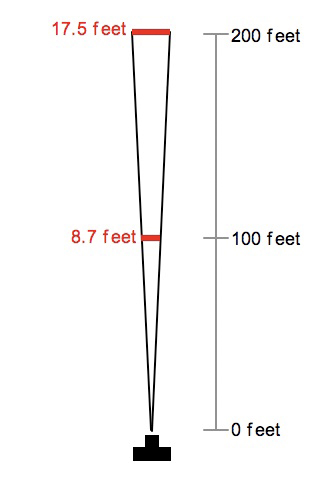
ps. the image is about FOV but it's the same principle.
Solution is you use 4stops for the 100feet and a 2stops for the 200feet since it will only see 50% of the 100feet the difference off the transition is 2 stops so they act the same.
Maybe you mean the same thing but explain it differently?
Not the right scale but this is what I mean.
A filter place at 100 feet can be twice as small as one placed at 200 feet.

ps. the image is about FOV but it's the same principle.
Solution is you use 4stops for the 100feet and a 2stops for the 200feet since it will only see 50% of the 100feet the difference off the transition is 2 stops so they act the same.
Stefan
K10D, K5
DA* 16-50, DA* 50-135, D-FA 100 Macro, DA 40 Ltd, DA 18-55
AF-540FGZ
K10D, K5
DA* 16-50, DA* 50-135, D-FA 100 Macro, DA 40 Ltd, DA 18-55
AF-540FGZ
Add Comment
To leave a comment - Log in to Pentax User or create a new account.




965 posts
17 years
Glasgow