First Image Attempt using HDR in photoshop UPDATED IMAGE

Posted 16/04/2007 - 12:04
Link
I see what you mean but would rephrase/clarify a couple of points.
* It seems to me that you are implying that the noise floor is sufficiently high that the bottom several bits of a 22bit file would essentially be too noisy to use anyway. I can well believe this.
* In 24bit audio actually I have been told that if full scale is made equivalent to 120dBA (not sonic boom level but still ear damage in a few minutes level) then the least significant bit is equivalent amplitude to the thermal vibration of an air molecule at room temperature. If this is true it makes more than 24bit audio capture pointless, unless huge amounts of unused headroom (ie low recording levels) are used to insure against unexpected peaks.
(In photography with proper metering there are no unexpected peaks since the highlights are right there and can be metered.)
Anyway in audio we still take care with recording levels, even in 24 bit, because the analog noise floor of the mics and preamps is well above the theoretical noise floor of the 24bit capture.
I suspect the same applies in photography. High bit depths are actually more needed for manipulation than for capture, to avoid artifacts. Even an 8bit photo would benefit from being converted to 16 bit having levels done in 16 bit and converted back to 8 bit to avoid posterisation. (but only if the 256 levels are dithered to 16bit, if the 8 bits added are just 0s it won't help) but i digress.
so really the brighter exposure of our notional 2 HDR exposures (which will have blown highlights) is needed not because 22bit is insufficient, but because the analog noise floor of the CCD is too high, thus the lower 8 bits of the 22 bits are too noisy to use, so an exposure with more light is needed to get the signal levels above the noise in the shadows.
(this is probably why they don't give us full 22bit raw files, OTOH if its so unusable why bother with the 22 bit converter in the first place?)(even 16bit raw would be a big step up from 12bit)
that was my thinking behind asking about CCD sensitivity, and the theoretical limit to all this HD and high bit depths, which would be detecting individual photons. (goodness knows what the quantum effects on the image would be!) I presume the analog CCD technology to do that is some way off, even though the computing power to process it and A/D it is probably available now.
sorry about digressions mid stream - I hope this post is still comprehensible!
anyway the above is my current understanding, please point out any wrong or questionable bits!
EDIT PS I take your point about not varying aperture, the depth of field variation would completely mess up recombining the exposures!
PPS since the limit to detail resolution is ultimately the noise level. and since if you take 3 identical exposures the noise will be the only difference beteween them, could you not in fact do a version of HDR with 3 identical exposures, or to put it another way, use that 22bit raw file , but lower the iso and increase the exposure length until the noise level in the shadows is equivalent to what it would have been with conventinal HDR.
or to put it yet another way, what we need is a 25 ISO setting and 22bit raw files...
* It seems to me that you are implying that the noise floor is sufficiently high that the bottom several bits of a 22bit file would essentially be too noisy to use anyway. I can well believe this.
* In 24bit audio actually I have been told that if full scale is made equivalent to 120dBA (not sonic boom level but still ear damage in a few minutes level) then the least significant bit is equivalent amplitude to the thermal vibration of an air molecule at room temperature. If this is true it makes more than 24bit audio capture pointless, unless huge amounts of unused headroom (ie low recording levels) are used to insure against unexpected peaks.
(In photography with proper metering there are no unexpected peaks since the highlights are right there and can be metered.)
Anyway in audio we still take care with recording levels, even in 24 bit, because the analog noise floor of the mics and preamps is well above the theoretical noise floor of the 24bit capture.
I suspect the same applies in photography. High bit depths are actually more needed for manipulation than for capture, to avoid artifacts. Even an 8bit photo would benefit from being converted to 16 bit having levels done in 16 bit and converted back to 8 bit to avoid posterisation. (but only if the 256 levels are dithered to 16bit, if the 8 bits added are just 0s it won't help) but i digress.
so really the brighter exposure of our notional 2 HDR exposures (which will have blown highlights) is needed not because 22bit is insufficient, but because the analog noise floor of the CCD is too high, thus the lower 8 bits of the 22 bits are too noisy to use, so an exposure with more light is needed to get the signal levels above the noise in the shadows.
(this is probably why they don't give us full 22bit raw files, OTOH if its so unusable why bother with the 22 bit converter in the first place?)(even 16bit raw would be a big step up from 12bit)
that was my thinking behind asking about CCD sensitivity, and the theoretical limit to all this HD and high bit depths, which would be detecting individual photons. (goodness knows what the quantum effects on the image would be!) I presume the analog CCD technology to do that is some way off, even though the computing power to process it and A/D it is probably available now.
sorry about digressions mid stream - I hope this post is still comprehensible!
anyway the above is my current understanding, please point out any wrong or questionable bits!
EDIT PS I take your point about not varying aperture, the depth of field variation would completely mess up recombining the exposures!
PPS since the limit to detail resolution is ultimately the noise level. and since if you take 3 identical exposures the noise will be the only difference beteween them, could you not in fact do a version of HDR with 3 identical exposures, or to put it another way, use that 22bit raw file , but lower the iso and increase the exposure length until the noise level in the shadows is equivalent to what it would have been with conventinal HDR.
or to put it yet another way, what we need is a 25 ISO setting and 22bit raw files...

Posted 16/04/2007 - 12:10
Link
Thomas - exactly
We're talking the same stuff here
More bits does not necessarily equal more information... primarily because of the noise issues. I thought I read somewhere that it only takes about 50,000 photons to saturate a photosite... I haven't the time to find it again, or the experience to work it out
And yet, the K10D does have a rather lovely output quality! (Slightly digressing, I read they had worked hard to remove any intermediate circuitry, which is why the 22-bit ADC turned up. They attribute the natural output quality down to this design.)
We shall see - I expect Pentax have a trick or two up their firmware sleeves...
Matt
We're talking the same stuff here
More bits does not necessarily equal more information... primarily because of the noise issues. I thought I read somewhere that it only takes about 50,000 photons to saturate a photosite... I haven't the time to find it again, or the experience to work it out
And yet, the K10D does have a rather lovely output quality! (Slightly digressing, I read they had worked hard to remove any intermediate circuitry, which is why the 22-bit ADC turned up. They attribute the natural output quality down to this design.)
We shall see - I expect Pentax have a trick or two up their firmware sleeves...
Matt
http://www.mattmatic.co.uk
(For gallery, tips and links)
(For gallery, tips and links)
Posted 16/04/2007 - 12:24
Link
Quote:
Thomas - exactly
I thought I read somewhere that it only takes about 50,000 photons to saturate a photosite... Matt
Whats a photosite? one pixel? If you only get 50,000 photons per pixel then least significant bit of a 17bit file would be less than one photon (!) which would make higher bit depths only useful for antialiasing against photon quantisation?Thomas - exactly
I thought I read somewhere that it only takes about 50,000 photons to saturate a photosite... Matt
more to the point, whats the minimum number of photons the photosite can detect?
Posted 16/04/2007 - 12:43
Link
Quote:
As a first exploratory exercise in a PhotoShop technique (one, I might say, that I haven't tried myself), I think it has great value, and may lead to great future skill. It's an interesting technique, and has lots of potential. So I salute him for having a go, and for his willingness to put his work up for scrutiny, not to mention his good humour when he gets a good slagging.
Talking of slagging, as a photograph to be assessed in its own right, I think it's pretty unremarkable, and has a few things about it that I really don't like. It's quite an achievement to get a shot of the sun as good as that, facing directly towards it, so long before sunset. But it still looks garish to me, with the white circle, the yellow ring round it, and the orange surround with its harsh border.
The blurred flowers ruin what would otherwise be a lovely foreground, and exposing for them should yield the rich colour that I'm sure they had. The silhouette of the tree is quite nice, and frames the sun, but how much more majestic would it have looked if the whole of the tree had been in the frame.
So as a photo, my reaction is quite negative, I'm afraid. For having an initial first stab at an interesting technique, one that might be useful in the future, top marks.
Having seen quite a few of Pete's shots now, my overriding sense is one of very unremarkable initial capture, followed by a lot of messing around on the computer that doesn't really recover the situation.
I strive to get the initial capture right. Usually I fail. But I think it's there, rather than in the subsequent sodding about that I think Pete should really put his efforts.
Just my tuppence worth.
Thanks Chris Very constructive criticism as usual.As a first exploratory exercise in a PhotoShop technique (one, I might say, that I haven't tried myself), I think it has great value, and may lead to great future skill. It's an interesting technique, and has lots of potential. So I salute him for having a go, and for his willingness to put his work up for scrutiny, not to mention his good humour when he gets a good slagging.
Talking of slagging, as a photograph to be assessed in its own right, I think it's pretty unremarkable, and has a few things about it that I really don't like. It's quite an achievement to get a shot of the sun as good as that, facing directly towards it, so long before sunset. But it still looks garish to me, with the white circle, the yellow ring round it, and the orange surround with its harsh border.
The blurred flowers ruin what would otherwise be a lovely foreground, and exposing for them should yield the rich colour that I'm sure they had. The silhouette of the tree is quite nice, and frames the sun, but how much more majestic would it have looked if the whole of the tree had been in the frame.
So as a photo, my reaction is quite negative, I'm afraid. For having an initial first stab at an interesting technique, one that might be useful in the future, top marks.
Having seen quite a few of Pete's shots now, my overriding sense is one of very unremarkable initial capture, followed by a lot of messing around on the computer that doesn't really recover the situation.
I strive to get the initial capture right. Usually I fail. But I think it's there, rather than in the subsequent sodding about that I think Pete should really put his efforts.
Just my tuppence worth.
A couple of things I might add are number one the experiment was done just to test out the HDR method as I have to send off a sunset image for grading but admit its not the best. I will re shoot taking in some of your ideas. I only have two weeks so heres hoping we get the sun again. I don’t have and can’t afford at the moment some ND filters so the method of taking several exposures and merging was the only alternative at the moment that I know of.
Quote:
Having seen quite a few of Pete's shots now, my overriding sense is one of very unremarkable initial capture, followed by a lot of messing around on the computer that doesn't really recover the situation.
For the above quote I agree I do mess a lot. I suppose I should concentrate more on getting a decent image right in the first place but in my defence I have done far less post processing than I used to and always concentrate hard to get a decent shot using the cameras features and what I have learned. Of course it would be fantastic if we could all take perfect shots every time but that's the thing with digital it does allow for editing and in some cases allows a poor image to be turned into something special if you know what you are doing. Even Pro's post edit admittedly not as much as many of us folk and also they may have more of an idea of what to do and probably take better shots to start with but it does happen all the same.Having seen quite a few of Pete's shots now, my overriding sense is one of very unremarkable initial capture, followed by a lot of messing around on the computer that doesn't really recover the situation.
Old school did not have this much control over images but I think having this is what is making digital photography one of the fastest growing hobbies around.
Pete
Wedding & Portrait photographer

Posted 16/04/2007 - 15:06
Link
Quote:
and in some cases allows a poor image to be turned into something special if you know what you are doing.
This is true of course, since you have total control over every pixel in software. But the worse the initial capture, the harder it is to fix all the things that are wrong with it - and the more it ceases to be photography and becomes painting with software.and in some cases allows a poor image to be turned into something special if you know what you are doing.
More to the point, as I've suggested, the result often isn't all that good, even after a lot of effort.
Posted 16/04/2007 - 16:26
Link
I went to download artizan, but its windows only.
Can anyone recommend free (or trial) software to try out the technique in Mac OSX?
(I do have a windows machine, but my mac is much more powerful, and is where all my photos are so I would much rather do it on that!)
Can anyone recommend free (or trial) software to try out the technique in Mac OSX?
(I do have a windows machine, but my mac is much more powerful, and is where all my photos are so I would much rather do it on that!)
Posted 16/04/2007 - 16:28
Link
Thomas,
This article is useful: http://en.wikipedia.org/wiki/Charge-coupled_device
This one mentions that 80000 photons is the "full" limit: http://astro.neutral.org/articles/tea/tea.html
If it's only 80000 in the K10D sensor, then 16-bits, or maybe 17-bits will be the maximum usable RAW limit.
Will see if I can find anything more concrete...
Matt
Quote:
Whats a photosite? one pixel?
Yes. Don't forget that a CCD is monochrome. So a photosite is the single pixel - either Red, Green or Blue. (i.e. there are not 30 million pixels in a K10D, but rather 5 million Green, 2.5 million Blue and 2.5 million Red)Whats a photosite? one pixel?
This article is useful: http://en.wikipedia.org/wiki/Charge-coupled_device
This one mentions that 80000 photons is the "full" limit: http://astro.neutral.org/articles/tea/tea.html
If it's only 80000 in the K10D sensor, then 16-bits, or maybe 17-bits will be the maximum usable RAW limit.
Will see if I can find anything more concrete...
Matt
http://www.mattmatic.co.uk
(For gallery, tips and links)
(For gallery, tips and links)
Posted 16/04/2007 - 17:58
Link
there must be a time factor involved too. 80,000 photons over what time period? you could reset the sensor and then keep counting from 1 again to up the total.
EDIT - i've just read that wiki, to do the above you'd need an interline sensor rather than the always on sensor and mechanical shutter of current cameras.
the colour mask thing explains some colour smear i've seen in some pics, bright red tulips against green grass has a slight aura around them, even though they were in focus.
EDIT - i've just read that wiki, to do the above you'd need an interline sensor rather than the always on sensor and mechanical shutter of current cameras.
the colour mask thing explains some colour smear i've seen in some pics, bright red tulips against green grass has a slight aura around them, even though they were in focus.
Posted 16/04/2007 - 18:23
Link
Hi All
This is a similar image using 4 images taken at different exposures. It seems to have better focus on the flowers and the sun is more pleasing to the eye. The composition is not as good though.
See what you think

This is a similar image using 4 images taken at different exposures. It seems to have better focus on the flowers and the sun is more pleasing to the eye. The composition is not as good though.
See what you think

Wedding & Portrait photographer
Posted 16/04/2007 - 23:49
Link
Quote:
It seems to have better focus on the flowers and the sun is more pleasing to the eye. The composition is not as good though.
Agreed. You can crop it to get much the same view as the original though. It's the left hand side that's rubbish in this one.
It seems to have better focus on the flowers and the sun is more pleasing to the eye. The composition is not as good though.
Posted 17/04/2007 - 11:37
Link
is anyone here using Photosphere for OSX for HDR?
If so I could use some help with it, maybe start a thread for it?
If so I could use some help with it, maybe start a thread for it?
Posted 17/04/2007 - 15:09
Link

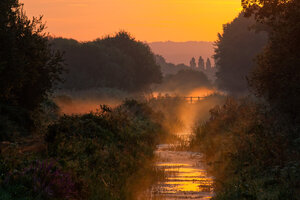
heres my first attempt.
lots of exposures from 1/25 to 1/3200 sec at f8. pentax M 50mm f1.4 lens ist DS.
vegetation was moving slightly in the wind, and tree in background out of focus intentionally.
combined using Photomatix, which is pants but the only thing I can get to work at present.
some curves in PS to enhance midrange contrast (at expense of looking natural)
there still isnt the shadow detail i would like. but its way better than i could ever have got with one exposure. it was a VERY contrasty scene.
so - i wouldnt regard this as right, but I can't seem to get the control to get it better in photomatix.
PS this is at 25% and completely unsharpened. its a bit soft actually.
Add Comment
To leave a comment - Log in to Pentax User or create a new account.



5870 posts
24 years
Sussex,
UK
I understand perfectly And in fact, I'm trying to persuade Pentax to include an optional 22-bit RAW format for that very purpose
However, it's not just down to the number of bits - you end up hitting the noise floor if you rely just on the ADC without adjusting the exposure. Assuming you have 12-bit RAW, the bracketing should be done by varying just the shutter speed! (Adjusting the aperture is a no-no!). This will give the cleanest result for all the captures.
A 5-frame bracket at 2Ev intervals represents an 8-bit range. Since you cannot afford to blow out the highlights, trying to capture a single image for HDR means you'll need to expose for the highlights. You'll get a reasonable amount of data from the first 12-bits of RAW - but exposing for the sun (in Pete's example) will mean you haven't got much in the highlights or midtones.
That'll leave the shadows, and you'll be trying to rake out the next 8-bits... and I reckon you'll hit the usable noise limit before you can do that properly - the noise of electrons rustling around gets in the way
So, yes, a 22-bit RAW would be better, but I still don't think it will obviate the need for at least two exposures to capture the full dynamic range in shots that include very bright highlights and very deep shadows.
Taking the audio comparison - 24-bit audio capture gives you more headroom, 32-bit processing allows more operations on the signal without introducing artifacts, but even with 24-bit you couldn't capture the full range of sub-whisper to supersonic boom! Even with digital capture in audio, you still have a limited range - and generally you can choose which range you are interested in capturing.
Hope that clarifies it some more
Matt
(For gallery, tips and links)