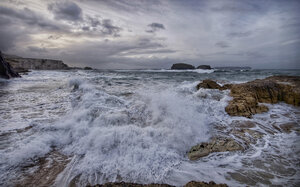
Award winning photographer Bill Ward recently announced the release of this first book 'Immersive' which is a collection of photographs taken within water using the ICM technique.
Posted: 10/09/2025 - 14:39
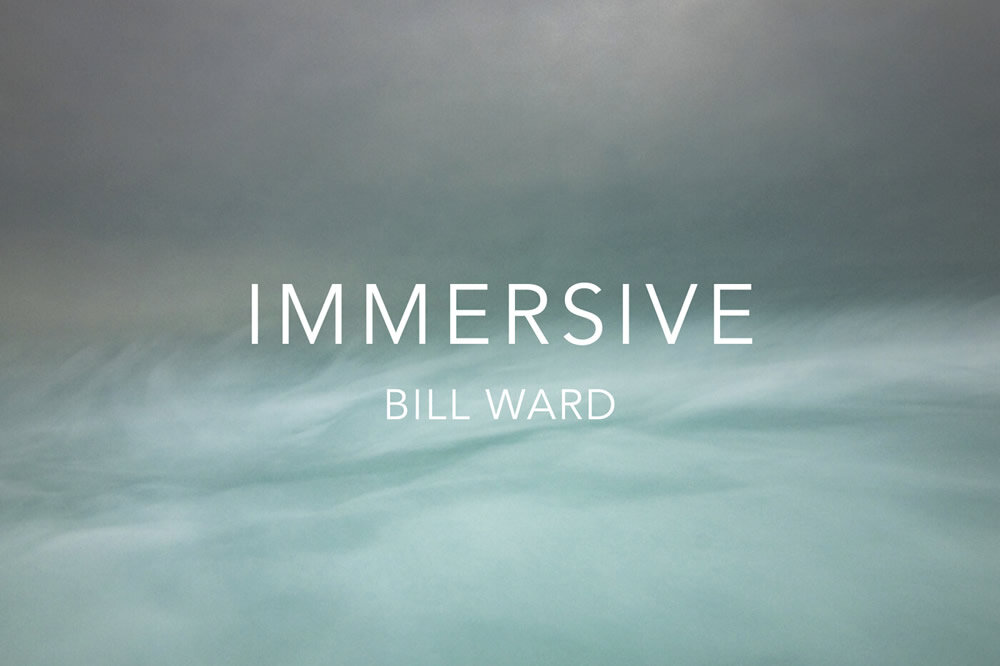
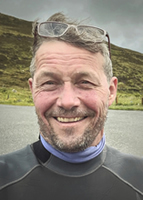 Multi-award-winning photographer and actor Bill Ward has spent the last four years quite literally throwing himself into the ocean in pursuit of something extraordinary. The result is Immersive - his first book with Kozu Books - a stunning collection of Intentional Camera Movement (ICM) images created in the breaking waves.
With a career that spans from Film & Stage, TV Dramas & Soaps to award-winning landscape photography, Bill has a unique voice and vision. We caught up with him to talk about the book, his creative journey, and what inspires him both in front of and behind the lens.
Congratulations on the launch of Immersive! Can you tell us what inspired you to create this book?
I've been investigating ICM for a number of years now, since 2012, back when, for many people, it was very much on the extreme fringe of the photographic world. I've always loved it for its feel, its ability to get under the skin of a place, a time, and take you to somewhere completely other. My photography is very much emotionally driven, and I find that ICM is very good at helping me to access that part of me, and also that part of Mother Nature.
Like many humans, I've also always been drawn to water. I've canoed, sailed, swam, body boarded, and surfed for 30 years. In many ways, water is my favourite photographic subject, fast moving water in particular. And while I really like being next to it and looking at it, I like being IN it more. About 5 years ago I had an idea about putting these two passions together, and Immersive is the result.
How did the idea of combining your passion for surfing with ICM photography first come about?
I suppose the idea primarily came out of a combination of frustration mixed with curiosity! As a surfer, I was intimately aware of the Zen of time spent in the water. The pov of land as seen from the sea. The sense of quiet, restful, calm, waiting in the line up, and then the sharp, invigorating release of energy as the ocean unloads into a breaking wave, and you try to catch it, ride it, work with it. The joy of it. The energy of it. The symbiosis of it.
As an ICM photographer, I'd spent many years photographing the water, the waves, the beach, the point at which the ocean meets the shore. And I was aware of the similarity of the feeling between that, and being in the water itself on a board. So I started trying to get as close to it as I could... getting in the water, in wellies, bare feet, trunks, shorts etc, trying to become as close to a part of it as I was able. But with a dslr, even one with as good water resistance as the Pentaxes, there was a limit to how close I could get.
And I started to wonder if instead of being on the outside of the water, as a spectator, what might happen if I could get on the INSIDE of it, literally IMMERSIVE myself within it, as I did on a surfboard, put a camera into the path of a breaking wave, and transfer some of the energy I'd always felt on a surfboard from the wave into the camera itself.
What was the most challenging aspect of photographing in the ocean rather than from the shore?
Numbers of things - firstly, water is wet! And DSLR's really don't like the wet! So if you're using a dslr for this kind of a thing, waterproof housing is key. Because of the other thing that I do for a living (I'm an actor for my sins, with a young family), I tend not to have a huge amount of disposable income, so I couldn't afford the full bells and whistles kind of bespoke waterproof housing. Particularly for a project for which I didn't have a precedent, and where I literally had no idea whether the outcome would be of interest photographically. What I did know was that I was really interested in finding out...
So I tried various cheaper, second hand bits of housing to begin with, to see if there was potential in the idea. Which worked brilliantly - until they didn't! But what they did teach me was that there was not only huge potential in the project photographically, but that I also absolutely loved doing it on a personal level. The making of the photographs themselves. It added a layer of physicality and movement to photography that I absolutely loved.
The project took four years - was there a particular breakthrough or "lightbulb moment" along the way?
Yes, three in particular. The first was holding a DSLR (in a wetsuit, with no housing) directly under a breaking wave, and then removing it as the wave broke (seriously, I don't recommend this - it's extremely high risk!). I realised there was huge potential getting up close and personal with it.
The second was using a Ricoh GRIII compact (which has a 3 stop built in nd filter to slow the shutter) and a waterproof bag - that showed me what might be possible if I persevered.
And the third was my first outing with a DSLR in budget waterproof housing... I found myself with the kind of photographs I'd never seen before and I absolutely loved the sensation of swimming and moving through the water with a camera... pure freedom.
What do you hope readers will feel or take away when they turn the pages of Immersive?
Something specific and individual for them. To ask yourself what it is that YOU are uniquely connected with... Photography is so personal. For me, it's all about a feeling. A sense of a thing. A place. A time. An energy. This project for me was about using ALL of myself, literally everything I have in a way I hadn't done before.
You've long been associated with ICM - what draws you to this way of seeing and creating?
The feeling of it... the movement... the sense of it... I often describe it as being less about the documentary reality, and more about its emotional accuracy, feeling, mood and the sense of the unknown - the journey of it - the improvisational nature of it - starting with one thing, and ending with another. The instinctiveness of it - to go with what you're given by Mother Nature, and to see what you can make of it - together.
Many of your images convey solitude and a sense of place. How does being in the water amplify that?
I go to quiet places deliberately. Either out of season or as much off the beaten track as I can find. And there is peace and quiet in the water in abundance... but there is also an energy here, a sense of being surrounded and literally immersed in nature... absolutely glorious.
What gear and techniques proved essential for surviving (and thriving) amongst breaking waves?
For the camera, it's all about the waterproof housing. Keeping water away from the body of the camera safely and effectively, but having something you can also physically maoeuvre and use with ease. That is going to be different things for different people. For me, it was an EWA Marine waterproof housing. Simple, effective, affordable.
And for me as a human, it's about staying as warm as possible, for as long as possible. The longer I stay out in the water, the more I find I tune in. So in the UK, that means wetsuits (a winter one - keeps you warm even in summer as the sun goes down).
Did you ever have any close calls with the sea or unexpected surprises while shooting?
I have a partner and young kids, so there's always an extra layer of personal responsibility in terms of safety that you feel as a Dad. I'm often out in the water on my own, as darkness starts to fall, so I'm particularly careful about checking for rip tides, and knowing the beach contours etc, swell size and forecast, the tide direction and coefficients etc (which change with the moon)... I'm always as careful as I can be about that kind of a thing.
You've won awards and judged competitions worldwide. How has that shaped your own photography?
Hmmm... that's a tricky question to answer. Particularly when I was starting out, and trying to gain a sense of the kind of thing I was making as a photographer, I did really value feedback from peers, and competitions was definitely one way of getting a sense of that.
Equally, though I teach a fair amount these days for Light and Land and for my own personal workshops, the one thing I'm very big on now is having your own sense of worth in your own work, making the kind of work that YOU want to make and doing it anyway, regardless of what other people think. Increasingly I think that's really, really important... otherwise it's quite easy to chase likes and just take the kinds of photographs that you think OTHER people may like.
Do you approach a photographic project differently from how you'd prepare for a role as an actor?
There are SO many similarities between the two, they're both creative arts, "making" if you like so they share all sorts of common traits. I tend to think of photography, like acting, as an "ensemble" pursuit. I'm making something "with" Mother Nature... not trying to impose my will on her... going with what's she's giving and responding accordingly. That's very much how I would approach acting: tuning in to what the other actors are giving on stage and responding accordingly.
At a broader level, Photography and Acting are very much Yin Yang for me. The acting world is the outer directed, extrovert part of my nature, the photography world the quiet, regenerative, introspective part. They both complement and balance each other.
You're also a Pentax ambassador and workshop leader. What's the most rewarding part of mentoring other photographers?
Helping them to explore their creativity and make work that surprises them. Increasingly I think that's what it's about... helping other photographers find their own unique voice. There's a technical aspect to it that is quite simple to get down... after that, it's all about the individual journey, finding what resonates specifically with each individual, and helping them pursue their own path.
Your work has been shown in galleries and magazines, but also resonates strongly with online communities. How important is sharing work in spaces like Camerauser and Pentax User?
I tend to think of the online world in general, and the creative world in particular as an idea soup. The sharing of thoughts, ideas, learnings, ingredients. Some of those ingredients will be readily available. And some of them will be unique to you.
So you get a massive pot and a whole bunch of ingredients, stick them in and mix them up and see what you get. Not just photographically... I try to be as open as I can be to any ideas from anywhere. When I was starting out 15 years or so ago, I found the Pentax community hugely helpful in helping with the technical aspects of photography, particularly lens choices and options. I also found it a useful place to float thoughts and ideas, and particularly when I was first working with ICM, a really useful space to chuck it out there and see how it lands!
If you could give one piece of advice to photographers just starting out with ICM, what would it be?
Take your time. Experiment, experiment, experiment. 5 out of 100 is a great hit rate. Don't worry about the ones that don't work (for you)... but do look at them and ask yourself why they aren't working for you. And if it's not working, change something: shutter speed, subject, quality of movement. Use the ones that don't work so well for you to help you make more of the ones that do... everyone's personal taste is different, so go after the things that bring you joy.
How do you personally balance the intensity of acting with the peace you find in photography?
Literally by doing as much of both as I can! They're opposite sides of the same coin for me... I love acting for its energy, its intensity, its vitality. But the more acting I do the more photography I tend to do to balance it out... I find photography calming, soothing, regnerative and hugely mindful.
Plenty of both works really well for me.
Fun & Quick-Fire
1. Ocean at dawn or ocean at dusk?
Dusk. I love the feeling of the end of a thing... the sweet sadness of letting go.
2. Which comes first: the idea for the shot, or the feeling in the moment?
The feeling... always the feeling.
3. If you had to choose only one: acting or photography? (We won't hold you to it!)
Both!
4. Favourite coastline in the UK - and why?
Northumberland - I grew up there and can never get enough of the white sandy beaches, the cold, the emptiness, the wildness.
5. What's next on your creative horizon after Immersive?
Such a good question. I tend to be project driven... and I currently have a thing about dandelions.
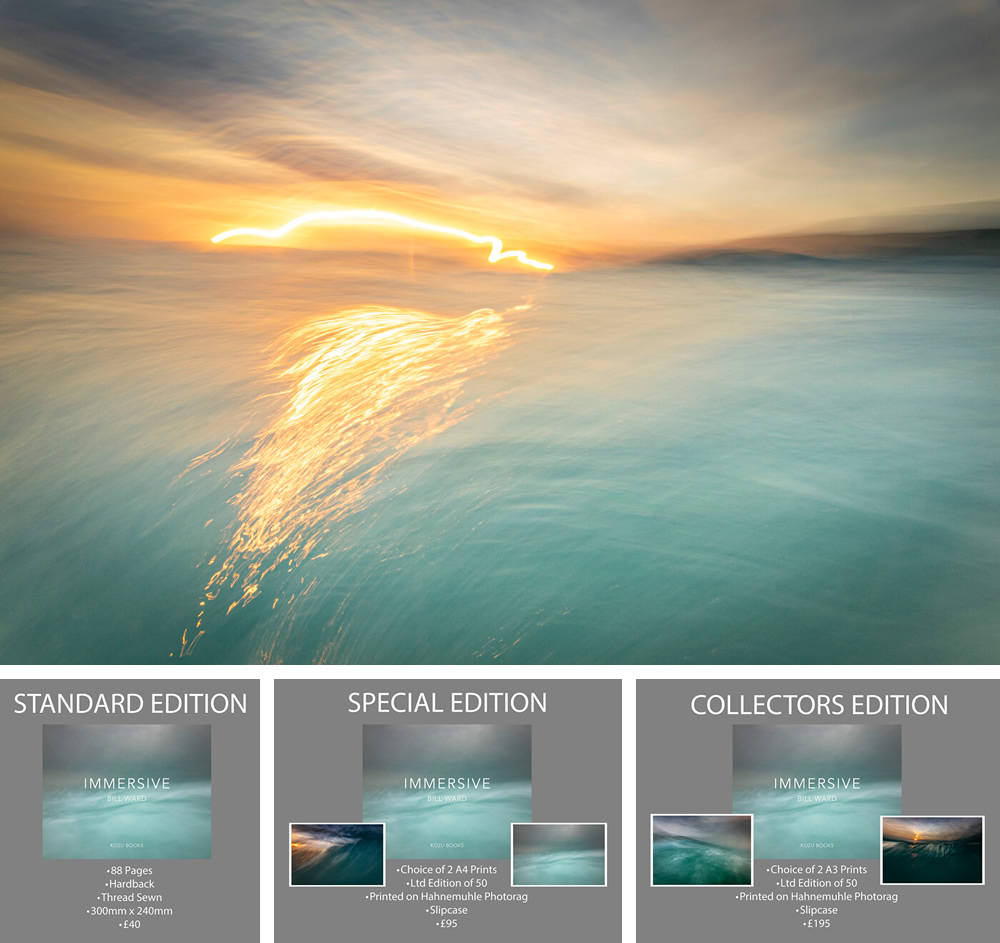
Bill Ward's work in Immersive reminds us that photography isn't only about capturing what we see, but also about feeling the energy of a place and moment. By plunging into the ocean with his camera, Bill blurs the line between observer and participant, inviting us to experience the sea as he does - raw, powerful, and alive. Immersive is available now for pre-order through Kozu Books.
Kozu Book | IMMERSIVE by Bill Ward
Add Comment
To leave a comment - Log in to Pentax User or create a new account.